Author: huntergilbert

Preview: Metal Gear Solid V: The Phantom Pain

A Game 25+ Years in the Making – Metal Gear Solid V: The Phantom Pain: Coming Soon

When I asked my fellow classmates if they had ever heard of the Metal Gear franchise, few had any idea what I was talking about. I find it kind of ironic that the franchise that created the stealth genre revolutionized 3rd person gameplay, and always attempted to be the best at telling stories in its own medium was, for the most part, off the radar of the average gamer. Created and still produced by the same man, Hideo Kojima, the Metal Gear franchise has spanned over 25 (It’ll be 28 in 2015) years! The original game, which launched in 1987 on the MSX2, was a top down stealth shooter that was well received in its day. After several top down sequels, the next innovative game in the series hit the original Playstation in the year of 1998. This title was called Metal Gear Solid and, once again, set the standard for stealth in gaming. In other words, all modern stealth games owe MGS for the common grounded standards of the stealth genre. The next sequel came to the Playstation 2, and was well received, but not as well as the following installment: Metal Gear Solid 3: Snake Eater, a prequel of the entire series. (I won’t even attempt to explain the storyline because of its complexity and sheer depth, qualities that make it such a great series.)  Metal Gear Solid 4: Guns of the Patriots was thought to be the final game, as it ended the story of the main character Solid Snake. Released for the Playstation 3, I honestly thought it was a concise and proper ending. I had no further urge for them to continue the series after ending it on such a high note. This, however, would change when I caught wind of Metal Gear Solid V: The Phantom Pain.

MGSVRU_1

Metal Gear Solid V: The Phantom Pain will be both a prequel to Metal Gear Solid and a sequel to Metal Gear Solid 3. It will follow MGS3′s protagonist, Big Boss (aka Naked Snake), whose DNA is cloned to form Solid Snake (the protagonist of MGS1, MGS2, and MGS4.) In MGS3, the prequel to the new game, Big Boss is the protagonist; a green beret turned CIA asset who is ultimately betrayed by his country for the greater good of the US in a Cold War missile crisis. Turning his back on the country that betrayed him, Big Boss forms a Private Military Company, MSF, in order to continue his work as a soldier on the battlefield. In last year’s mini game, though, Metal Gear Solid V: Ground Zeroes (which takes only around 1-4 hours to beat and acts as a demo for the full game) Big Boss loses not only his company but also many of his close friends. His life work, built by his own blood, sweat and tears, is destroyed in a sneak attack by an unknown faction. This is where Metal Gear Solid V: The Phantom Pain picks up.

9 years after barely surviving an explosion from a device implanted inside of a female character (and possible love interest in Ground Zeroes), Big Boss (I’ll call him Snake from here on) awakes from a medically-induced coma and is informed of his condition. He lost his entire left arm from the elbow down in the explosion, and suffered severe injuries to his face from the shrapnel, thus explaining the chunk of metal in his head that can be seen in promotional trailers and screenshots. Not long after this, the hospital Snake is being treated in is attacked by unknown forces, presumably the same that destroyed his company and killed most of his friends. Somehow Snake gets escapes, and what follows is mostly unknown. What we do know is that Snake somehow arrives in a early 1980′s Afghanistan and is told by his long time rival, Revolver Ocelot (voiced by Troy Baker) that his best friend Kaz Miller (known as Master Miller to others) survived the explosion and is still alive and being tortured by Russian Observers in a fire base deep in Afghanistan. This is where the first known actual gameplay of the game occurs.

MGSVRU_2

Metal Gear Solid V: The Phantom Pain is an open world stealth/action game, which ties into the first mission quite well. The player is tasked with gathering intel on Kaz’s exact location and must plan an infiltration to rescue his friend while maintaining a discreet form of engagement with the enemies. What makes this game stand out from other open world games is the mere scale and attention to detail in the first level alone.  The playable area of Afghanistan is about the size of Los Santos from GTA:V, and have I told you that Afghanistan is one of 8 free roam areas in the game?!? This presumably makes the playable area of Metal Gear Solid V: The Phantom Pain 8 TIMES LARGER THAN GTA:V! The game also runs the best game engine when it comes to lighting, graphics, sound and physics. All cutscenes and gameplay are processed through the same engine making the graphical difference between gameplay and cutscenes almost impossible to notice. The gameplay and cutscenes are so lifelike that camera stills of child soldiers were used by a news broadcast describing the life of a child soldier! (Link for the non believers.)

MGSVRU_3

The game’s world will also feature real time weather and passage of time, which at first may not seem that impressive,, but the scale is what makes it so impressive. When I say real time, I mean the game follows real time as in each hour in game is an hour in real life. This adds a sense of immersion into the game since for the first mission you are given 3 days to save Kaz. Luckily, players can speed time up if they want to raid an outpost at night since the AI in the game takes into account the actual view and awareness of your enemies in varying situations. The weather also plays a role in this, severe sandstorms prevent communication and obscure the enemies’ line of sight in the Afghanistan area and so far the only other weather feature shown in the Zanzibar region of the game has severe tropical storms that restrict movement and visibility. This will also affect piloting helicopters and driving vehicles such as tanks or APCs as the player. The game worlds themselves were created with options in mind. As Snake, the player has every option and tactic in the book in order to achieve his goal, whether that be sneaking into a supply cache for weapons and setting a charge to detonate on it at a safe distance to calling in reinforcements from your home base to do a frontal assault on a compound. You can even call in helicopter to level your enemies fortifications while humming Ride of the Valkyries.

The game, shouldn’t be all that difficult to a new player, at least on easier difficulties, but it will test your patience in stealth situations, where you as a player will be forced to make split second decisions that could possibly compromise your entire mission. Combat will function like any other 3rd person shooter except for bullet range, wind and trajectory, which will all be key to your success. For example, you will have to adjust your sights when using a tranquilizer gun or a suppressed weapon because combat level suppressed weapons use chilled rounds which, in turn, make them drop far more than unsuppressed bullets. Also, just like they do in real life, suppressors wear out over time, an aspect you should keep in mind since stealth is essential to this genre of game. The player will also have to hide bodies of dead or incapacitated soldiers in order to keep the other unaware. This, added to the fact that enemies will in some cases infinitely spawn/ be deployed into the battlefield as long as they maintain communications and a line of sight of the player, makes the run and gun option viable only in small encounters, which means you as the player will have to use your brain and tactics in order to fool an enemy that severely outnumbers you.

MGSVRU_4

Customization and play styles are also fully up to the player, if you want to go into a fight guns-a-blazing with a belt-fed machine gun, revolver and RPG like Rambo, go ahead. If you want to take the stealthy and smart approach (the only viable option on harder difficulties), you can enter the battle as a silent killer with a suppressed sniper rifle, tranquilizer gun and bowie knife; it is entirely up to the player. Since the game isn’t even out yet, I’m sure there will be more features and other combat aspects of the game. In addition to customizing your own Snake, the player will also be attempting to recreate their old PMC operation as a sort of base-building mini game. This takes place on and off the battlefield, since armaments and ordinance captured in game can be shipped back to your mother base. If you aren’t the stealing type you can also purchase improvements for your base with resources you find in game, and trust me–you will need them. The only revealed aspect of multiplayer so far is a game mode where you attack other bases in Clash of Clans-esque raids where you lead recruits and members of your own PMC group, The Diamond Dogs, against another player and his forces that include everything from guard dogs to drones, tanks to jets. It’s worth pointing out that another game mode will be revealed later this month so this will not be the entirety of the multiplayer side of MGSV.

MGSVRU_6

However, unlike other games on the market, the story mode and journey the player will take part in as Snake will be the major focus of the game as a whole. When I say journey, I mean the fact that, at the beginning of the game, you are a hero, fallen from grace and seeking revenge on those who harmed those close to you. You aren’t fighting for a country, an ideology, or even god for that matter; your character wants nothing short of revenge after everything is taken from him. This sense of loss and remorse portrayed by Snake, voiced by Kiefer Sutherland,will be the theme of the game. As players of Metal Gear Solid 1, 2 and 4 already know, Big Boss or Naked Snake, ends up becoming the antagonist and evil figurehead of the other games. Players already know how it ends, yet the transformation of this iconic character from soldier of fortune hero to cold-blooded killer he becomes later in his life is currently unexplained by the other games. Metal Gear Solid V attempts to answer this 25+ year old question as to how this character is overcome by his own emotions and demons. The player must sadly endure this tragedy and fall from the heroic standard down into the turmoil embodied by the character in other games. Themes that will be touched on in this game include, torture, drugs, violence, sexual crimes, and child soldiers to name a few. (If my description of this isn’t getting the point across watch this trailer. Link right here)

MGSVRU_7

Hideo Kojima, the creator of the game, stated that he wants players to realize that even the best people in regards to purpose and moral identity can fall from grace and become the very thing that they are fighting against. In this case you are Snake and his Diamond Dogs (his PMC) fighting against a unknown and mysterious faction, yet as players of previous games of the series already know, Snake and the Diamond Dogs are perfect exapmles of this idea later on, committing horrible atrocities against humanity. This idea of a tragedy isn’t new to anyone, the medium and mere 25 years in real life to complete it however has not been done before. A 25+ year old game series has led up to this climactic ending, and you, the player, will be forced to watch it and no doubt commit awful acts of violence. Let me be clear, this game is not for the faint of heart, its portrays war and violence in an incredibly realistic and gritty nature. In my opinion it does this better than The Last of Us, and this is coming only from the demo prequel and trailers for this game.

Hideo Kojima also stated that he wants the player to question their own morality as they play this game, because gaming as a medium allows the player to interact with a world and receive a story in a way that movies and books simply can’t. Everything will be from your perspective; you as the player will have to pull the trigger of the gun trained at the back of your friends. You will have to execute your soldiers for desertion and spying against you. As a human, Snake will ultimately destroy everything and everyone around him, acting as an emotional time bomb. Yet the mere event that causes this dramatic shift in the character’s personality is unknown to players and excites me the most when it comes to this games story.

MGSVRU_5

The player as Snake will ultimately embrace their/Snake’s inner demons and become the bad guy. This will occur throughout a long process since the game is rumored to be the LARGEST CONSOLE GAME EVER at a size of over 100GBs! This means the game will more than likely be 2-3 Blu Rays discs and will take up 1/5 of the space on the new next gen consoles. The game itself is being developed on the PS4 and will be ported to the Xbox One and PC, with a crummier version being put on the PS3 and Xbox 360. (Since it can’t read blu-ray discs, there will be about 9 discs for the install on the Xbox 360. Good luck.) An additional exclusive disc of content is rumored to be on the PS4 since Sony and Konami, the games publishers, have always been very close to one another (All Major MGS main game entries have been Sony Exclusives).

In summary Metal Gear Solid V: The Phantom Pain will make the player question their moral compass in this third person action/stealth free roam game. It will be the final entry in the series from Hideo Kojima, who will be working on Silent Hills and has no further interest in the franchise after what is sure to be a conclusive and bittersweet end. No set release date has been set for MGSV but Kojima promised a 2015 release, as the game has been in production since 2008. I personally am predicting that this game will win game of the year 2015 with its simply superior graphics, benchmark story, gameplay and development history seen in just the gameplay trailers. No doubt from a mere data standpoint, this will literally be the biggest/largest game ever released on a console, so it has that going for it.

Here is a final fan-made trailer that is a compilation of the best moments of the trailers that have been released thus far.
Review: Far Cry 4

Elephants, Assault Rifles, and Bears, Oh My! Far Cry 4 Review

Ubisoft has had their fair share of disappointments and failures this year when it comes to game releases, excluding Valiant Hearts, one of my favorite games this year. Far Cry 4 helps break their bad streak and delivers to its audience after the success of its predecessor: Far Cry 3. Far Cry 4 is set in the fictional country of Kyrat, which is modeled after Nepal’s Himalayas, and in which the player returns to his homeland to scatter his mother’s ashes. Problems arise when he becomes quickly entangled in a civil war with close ties to his family and lineage.

FC4_3

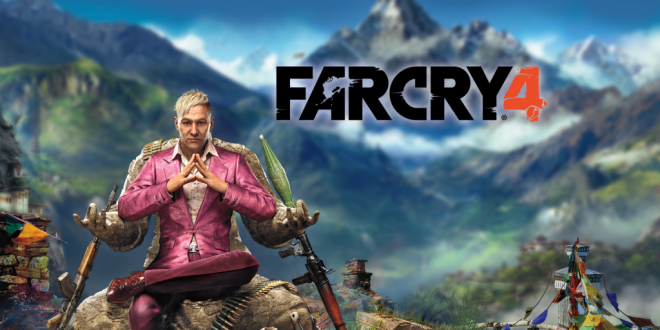
The story in Far Cry 4 isn’t going to win awards, but it does attempt to naturalize itself more. Unlike the previous Far Cry games, the protagonist hails from the location you travel through in the game. Incredibly unique characters, such as an African Warlord-turned Christian who ties everything he says to scripture, are still very much present in the game. The character’s now ironic fighting for God contrasts nicely with the world in anarchy. However, the character that steals the show is the antagonist, Pagan Min, who is voiced by fellow Texan and veteran voice actor, Troy Baker (Seriously this guy is in everything from JRPGs to Call of Duty.) Pagan Min is essentially the king of Kyrat; his image is on all of the currency and propaganda describing his “light” is played throughout the in-game radio. The character himself is actually quite reserved excluding two scenes in game, including one in which he stabs his own soldier to death then complains about the blood on his shoes. Pagan Min is anything but intimidating physically, yet he is absolutely sinister, and Troy Baker nails the dialogue and atmosphere of this self-proclaimed king. Other characters are noteworthy but are simply overshadowed by this performance.

FC4_2

Gameplay in Far Cry 4 is almost exactly the same as Far Cry 3. Some may see this as laziness, but it works. In other words “if it isn’t broken, don’t fix it.” The POV of the game is first person, making this game a open world FPS/Adventure game. Players are able to carry up to 4 weapons at once after skinning animals for pelts for holsters. The amount of ammo, syringes, explosives, etc. are also all-dependent on how many skins of animals you have collected. As mentioned earlier, the player can also craft syringes to recover health and add temporary boosts of speed, strength etc. All of these boosts are made from various plants the player can discover in the land of Kyrat. Skill points are also gained from leveling up which can be used to buy attributes and abilities that will further strengthen the player in the harsh Himalayan environment, an environment that is filled with animals that will absolutely tear the player apart, such as bears, leopards, tigers etc. The wildlife continues to be just as much of a threat as the enemy factions’ soldiers. This idea of fearing nature has been prevalent in nearly every Far Cry game.

FC4_4

Side missions in the game range from hunting wild animals to freeing hostages who are being held at gunpoint by corrupt government forces. Players of the previous game will be no strangers to the idea of radio towers (bell towers in this game) and outposts which populate the countryside of Kyrat. These strategic points of interest must be taken over in order for you player to be able to expel the corrupt and oppressive government forces that occupy them. A new strategic military installation in this iteration of Far Cry is the addition of fortresses, which are basically outposts on steroids. These massive forts must be weakened before the player, by themselves or with a friend, attempts to take them over. In order to take one over, the player must eliminate all alarms to stop forces from entering the fort and must eliminate all forces inside of the fort. Seems easy right? Well it is at first until helicopters full of soldiers begin making runs over the fortress while you scramble to disable all of the alarms. Experimenting, a friend and I decided that sniping the alarms from far away in co-op mode with suppressed snipers made this task of capturing the fortresses and outposts far easier. Just place yourself on a hill with your friend (if you have any) and snipe at the bright yellow alarm boxes before the enemy even notices you are there. After the alarms are gone feel free to unequip the sniper rifle and head on in like a patriot and liberate the installation like a true American, by blowing the entire thing up. That is merely one approach, but seems to work the best from my experience so far.

FC4_8

As mentioned earlier, outposts, fortress, and just about everything other than main story missions can be tackled with the cooperation of a friend or stranger over PSN/Xbox Live/Steam (dependent on platform). This further helped display the sheer amount of fun you can have in this game when you play with a friend. For example, I drove a truck with a mounted machine gun on top while my partner disabled a truck full of soldiers while we raced down a Himalayan mountain road at incredibly fast and fun speeds. Fishing with TNT couldn’t be any more fun with a friend, but don’t blow yourself up along with the fish (I learned that the hard way). The aspect of having an open country to mess around in with your friends whether it be liberating the land like a patriot, hunting exotic and endangered animals (do not attempt in real life), or just racing quads down a mountainside, Far Cry 4 provides fun cooperative situations for you and a friend.

The PVP multiplayer is an arena based 5v5 matchmaking that honestly could be better. It becomes rather repetitive after several matches yet it wasn’t bad, it just merely doesn’t stack up to the rest of the game. In my opinion it should have been dropped entirely and replaced with a 4 player co-op campaign like the one in Far Cry 3. That co-op campaign was surprisingly fun for what it was when played with friends. To be honest I kind of missed it and was disappointed by its lack of continuation in this iteration. However, the co-op mode, where a friend can drop into your session, is a good addition to the overall gameplay of Far Cry 4.

Verdict: 9.5/10* (if you haven’t played Far Cry 3) or 8/10* (if you played Far Cry 3)

Far Cry 4 is a nice addition to the franchise yet it fails to exit the shadow of Far Cry 3. However, if you did not play Far Cry 3 you will have an absolute blast with this free roam FPS adventure game. Even veteran players of the series will be fond of new additions to gameplay; however, it won’t feel like an entire new experience.

Still Loading: Net Neutrality

Still Loading: Net Neutrality

Our Constitution, which acts as the standard for political and social policies, states, “We the people,” and is followed by the rest of the preamble describing a basic understanding as to how our nation as a whole should be run. It focuses on the idea that the common people of the United States of America have the right to dictate and control their government, thereby insuring them the hope of obtaining and keeping basic rights that are thought to be insured to them by our founding fathers. One would argue that since humanity is in an age of information, two people from different sides of our planet holding a face to face conversation is a given right that should be insured to every American. The Internet acts as a highway of knowledge and opinions, not to mention entertainment and leisure. It has brought out and led, in my opinion, to some of the best innovations in the past decade. So let me ask the average American one question: Do you believe the government has the right to cap and/or take away this right that acts as the doorway to a greater understanding and connection to the rest of the world?

Net Neutrality, a term coined near the dawn of the Internet, states: that Internet service providers and governments should treat all data on the Internet equally, not discriminating or charging differentially by user, content, site, platform, application, or mode of communication. This has been the standard and backbone to the Internet when it comes to providers and consumers of their services. Yet recently, this ideal, and in some aspects this right to a free Internet, has come under attack from corporations and politicians’ political agendas.

Some Internet providers and politicians who are supported by such providers claim that data can be used to discriminate and differentiate from user to user. In other words my data and Internet required to play a match of Halo or binge watch a series on Netflix will cost more than a person who is emailing a friend or reading a politically-biased news source. In other words, what you are doing on the Internet will effect and raise the cost for you as a consumer.

NetNe

Some Internet service providers claim this will allow for what they are describing as fast and slow lanes on the Internet: fast ones for highly-demanding activities such as watching Netflix or doming your friends in a match of slayer on Halo. The slow ones would be for people who aren’t demanding as much bandwidth, people who might be sending emails or reading their poetry or whatever. The thing is this would be understandable if, as a nation, we actually had high-quality Internet. According to a recent study by Ookla Speedtest the strong and proud United States ranks 31st in the world in terms of average download speeds. Quite shocking when many Americans are thought to believe we get the best “everything” while other countries such as Estonia, Hungary, Slovakia and even Uruguay have better averages than the U.S.’s measly 20.77 Mbps. The statistics are even worse on the upload side of America’s Internet speeds, which clock in at a sluggish 6.31 Mbps—a speed beaten by Lesotho, Belarus and other countries you have probably never heard of because the U.S. comes in at 42nd in the world.

netNe2

As one can see, this justification of giving consumers fast and reliable Internet through fast and slow lanes would be great if it were possible with the standards Internet providers are already giving us. We already pay unreasonable prices for crummy Internet: for example users in Seoul, South Korea, pay the equivalent of $30 a month for 1 Gigabit Internet which is 50 times faster than the national average! The price for obtaining this fast of a connection costs U.S. consumers around $300 in Los Angeles or New York according to the annual report by the New America Foundation’s Open Technology Institute. This is the outcome of a market dominated by large corporations who have a stranglehold on consumers. And after all of this, they expect us to pay more?

Some politicians, such as Ted Cruz, who just so happened to accept $47,000 in campaign funds from the telecom industry, including AT&T, Time Warner Cable, and the NCTA, believe this to be justified. He claims that “‘Net Neutrality’ is Obamacare for the Internet; the Internet should not operate at the speed of the government.” (Taken from his tweet on November 10, 2014.)

netCruz

He is right when it comes to the fact that the Internet shouldn’t operate at the speed of the government; it should operate faster. This would be impossible if providers such as AT&T, Comcast, Verizon, and others got what they wanted. In reality these corporations fear the thought of the average American consumer discovering that the rest of the developed world has better services than them. They are attempting to coerce politicians to eliminate Net Neutrality under the radar before common people realize what is happening.

Yet not all politicians are against it. President Obama came out recently supporting Net Neutrality, and since I don’t always agree with his policies this was a pleasant surprise. He advised the FCC to reclassify Internet service as a utility under Title II of the Telecommunications Act. So in summary, the government as a whole isn’t out trying to cap our Internet speeds; it turns out the only ones who support this are the ones who directly benefit from funds from these corporations. The citizens also shouldn’t look at this topic from a liberal or conservative perspective; issues such as Net Neutrality can’t be observed from a political lens. Instead, the average consumer and citizen of the United States should think from an individual perspective as to how this will affect their lifestyle and budget.

netNe3

Net Neutrality to me personally would greatly hurt my hopes and dreams of becoming a journalist for a company that reviews or discusses entertainment and other forms of media. I would more than likely have to take down my website I currently run and would have to pay fees for subpar Internet. The Internet provides writers, including many other students and recent college graduates, a place to voice their opinion to the masses. It allows one to be heard, or at least have a place to speak and give their two cents on an issue. By capping Internet speeds these certain politicians and Internet providers would be stunting and killing off the dreams and intentions of the younger generation. These same politicians say they are supporting this with the intentions of helping our generation, a generation that, let me remind you, is fueled by knowledge and the ease of connectivity on the Net.

Why should they be capping and controlling the very thing that has brought about and led to the most innovation in the past 10 years? What could possibly be the other morally right answer to this? The fact is there isn’t. This attempt to kill Net Neutrality benefits no one except the Internet service providers who essentially have a monopoly on the service, as well as the politicians who line their wallets with funds from these companies. It’s easy to agree to something when you have no idea what they are arguing and or seeking. This is why since Ted Cruz is from Texas I would actually very much enjoy sharing some coffee or tea with him so he can hear my opinion as someone who would be affected by this. This seems reasonable since I myself can’t be heard in politics since I myself as a 17 year old can’t vote. I, myself, and the young rising generation of our nation should have the right to voice our opinions on something that would damage our future so much since the Internet and technology is the future. If more young individuals were aware that this was even happening—if they knew what would be taken from them—they would surely stand up in large protests against this political agenda.

As a final note, no other countries have this sort of differentiating between data in order to charge for Internet services. They also have far faster Internet speeds than we do in the United States. So please someone explain to me as to why we as a nation must pay so much for honestly some of the worst service there is out there? The answer is simply monopolies and their stranglehold they have on consumers in our nation. They should be put in their place and checked because there is no freedom behind killing Net Neutrality. Isn’t this the land of the free?

Review: Call of Duty Advanced Warfare

Recycled Warfare – Call of Duty: Advanced Warfare Review

Every year Activision sets aside a large portion of its staff to release a new game, one that lacks originality but is made up by including re-skinned weapons and assets. Call of Duty: Advanced Warfare is no exception to this trend. Originally promising intense new combat via exoskeleton battle suits and a compelling story with Kevin Spacey, this game fails to exit the shadow of its past iterations in this aging franchise. After the poor release and reception of last years Call of Duty: Ghost one would think Activision would finally decide to change its formula when it comes to making “Innovative” and “Blockbuster” games. In my opinion Call of Duty hit its high point with either Call of Duty 4: Modern Warfare or Call of Duty: Modern Warfare 2, every addition to the franchise has continued to show that the franchise lacks innovation and new ideas.

Gameplay in Advanced Warfare isn’t anything new. Any past player of the franchise will have no problem stepping into this game, and if you’ve played one, you’ve played them all. The exoskeleton does add some new aspects to the game such as increased jump height and free running skills. Yet this isn’t anything gamers haven’t seen before, this kind of game play is anything but new. For example Titanfall, a game I wasn’t even that impressed with, had far superior free running and gameplay compared to Advanced Warfare. The game is far more fluid than any other Call of Duty, but that isn’t saying much. What keeps Advanced Warfare from being a noteworthy addition to the franchise is Activision‘s lack of common sense, since developers need more time to make a successful game. Previously, two-year cycles were given to developers when they were given the task to create a sequel. Now the developers have three years to make a new game. The problem is that this isn’t enough time to make a truly revolutionary and innovative game. As one of the largest publishers of video games in the world, Activision should strive to put more resources into the development of their stale titles.

When it comes to graphics Advanced Warfare isn’t ugly, but when compared to other games that have come out or are about to come out, it simply lacks the next gen touch. The differences between last gen and next gen are only noticeable when you pause the game and compare frame to frame because when you are in the heat of battle in this generic shooter the last thing you will notice will be the anti-aliasing and lighting in the game. This handicaps Advanced Warfare from being a noteworthy game. When juxtaposed to Metal Gear Solid V: The Phantom Pain or The Witcher 3: Wild Hunt, Advanced Warfare is a sad excuse for a game when it comes to visuals. It simply can’t compare to rival games. This is the outcome of Activision’s decision to use the same in house game engine on both last gen and next gen versions of their game. For the first time in 7 years Call of Duty finally has a new game engine. The previous engine, in use since 2007′s Call of Duty 4: Modern Warfare (my favorite of the series), was showing age and entering the end of its life cycle, which was quite noticeable with last year’s disaster of Call of Duty: Ghosts. Many other developers are shifting away from the last gen, which is good for next gen games since porting it to last gen handicaps the game on the next gen which simply isn’t fair. Ubisoft already made two different Assassins Creed games for each generation; this gives players the best version of the game that they can get on their platform, yet Activision is too greedy to do this. They are too busy milking money from consumers who honestly deserve better than this.kevinSpacey

This game, however, isn’t all bad news: the story in Advanced Warfare is the best I have played since Modern Warfare 2, the story shows a grim future for the world. In the year 2054, the world’s military is run by Private Military Corporations, and the player works for Jonathon Irons, the CEO of Atlas voiced by Kevin Spacey, the largest military power on the face of the planet. The player is joined by Jack Mitchell, voiced by my favorite veteran voice actor Troy Baker, a former marine who has joined the PMCs since they are now the most effective fighting force on the planet. The campaign shows a bleak future where wars are fought by people who are driven solely by wealth and political gain.

codExThe campaign does a great job of introducing future tech such as exoskeletons into the game. The future tech is a nice addition yet the vehicles feel clunky and unpolished. Personally, I believe the Call of Duty franchise should stay away from vehicle combat. However, the story is executed with amazing precision; Kevin Spacey provides a performance that rivals that of many cable television shows, which is great for the story telling in the video game medium. The campaign isn’t the longest, but unlike the recent Call of Duty games, this one is actually worth playing.

Multiplayer is everything you can expect from a Call of Duty game. For the first time ever, skills and perks are logically explained. While in previous iterations of the game your player character can reload at unrealistic speeds and have infinite sprint is finally answered for, the solution to these unrealistic game play ideals is… exoskeletons! The exoskeletons provide more verticality and speed to the game, adding some much needed life to this dying franchise. Skills and perks are integrated into your own personal exoskeleton, which finally solves the weird mystery regarding your soldiers amazing physical prowess. The maps are fun, and they share ideas and play styles from the last games maps. All in all, the multiplayer is great if you seek repetitive game play, yet this game is still a lot of fun to play since it isn’t that difficult to be good at. So if you feel like gunning down your friends in an online match, pick this game up.

Verdict: 7.5/10*  What makes my review different from writers at IGN, Destructiod or Polygon is the fact that, unlike them, my job doesn’t depend on the success of a video game or the industry in general. I can give my honest opinion without receiving any backlash from publishers and developer. This gives me the ability to give an honest opinion, one that isn’t cropped by large corporations or overarching editors. In other words I don’t have to comply to untrue reviews from these large companies.

Call of Duty: Advanced Warfare suffers from the failure to break its own mold preset by past iterations. It still retains its casual game play which makes it such a good series yet it disgraces its past noticeable iterations by lacking innovation and true change. Sure, Advanced Warfare has game changing “exoskeletons,” but it absolutely cannot bet compared to the great games in the franchise such as Call of Duty 4: Modern Warfare and Modern Warfare 2, which were hallmarks in the FPS genre. With so many other Call of Duty esque games on the market, Advanced Warfare fails to distinguish itself from these “knock-offs,” some of which honestly deliver a better package than this. As a consumer, it’s up to you all to choose whether or not to buy this game. If, as a consumer, you were to not buy this game, you would be showing your disapproval in the industry and would force innovation and change in the game industry. This would provide gamers with better quality games than this one and other poor excuses for games. In the end, consumers make or break the video game industry, and honestly any industry that is noticeably successful. You can blindly buy this game and fuel this corporation’s greed for money or you can pass on it and buy a decent game.

Review: Sunset Overdrive

I have to say I had low hopes for Insomniac Games’ newest title, Sunset Overdrive. Insomniac Games has a track record of making either really good or really bad games, among the better titles include Ratchet & Clank & The Resistance series. On the poor side of their past games are titles such as Fuse, which was an all around failure when it came to gameplay and story. This mixed bag of games made me feel uneasy when it came to the pre-release of Sunset Overdrive, but thankfully most of my predictions were wrong, although some remained true.

Sunset Overdrive takes place in a dystopian metropolis by the name of Sunset City in the year of 2027. The player works for a company by the name of FizzCo, a large corporation that owns and controls multiple different markets and acts as the antagonist in a way since they caused the situation in Sunset City. During one of FizzCo’s parties to launch their new energy drink, Overcharge Delirium XT, the drink ends up turning the consumers into mutants. These fast running mutants often roam in hordes and are the main enemies players will encounter in this collapsing society. There are also specific kind of mutants (this idea of specialized infected is a call back for me at least to the Left 4 Dead series). While the mutants may be fast,
their AI isn’t exactly the most advanced when compared to other titles;  the shear amount of enemies you will encounter in the streets of Sunset City, though, is esunset overdrive articlenough to make up for the lack of intelligence in the mutants. In summary, the story and plot is the last thing you will be worrying about – instead Insomniac provides players with a unique run and gun type of game play.

The gameplay is what really makes Sunset Overdrive a worthwhile game. It combines aspects of free running, running-and-gunning, and both  vertical and horizontal traversal all into a smooth and fluid process. The aiming feels a lot like Saints Row and the grinding aspect, oddly enough, where you use rails for transport reminds me of the older Tony Hawk games. The developers obviously want players to be mobile on all terrains since your character is pretty slow on the ground. This forces the player to move since if you stay on the ground, you will be swarmed by the mutants. That being said, you aren’t completely safe on the rails, but once you are there you don’t have to worry about balancing yourself like in the Tony Hawk games. The wall running also comes in handy as you make your way around the collapsed city.

The overall atmosphere of Sunset Overdrive isn’t that original. Its blatant humor and perverted jokes take obvious aspects from comical games such as Saints Row. I found the over-the-top jokes to be too “out there” and honestly some of the references felt uncomfortable. In other words, the game doesn’t take itself that seriously, which in some people’s opinions doesn’t really matter. In my opinion, I felt that the games humor simply wasn’t targeted towards my own age group, and its tone would suite far better with a younger age group, if the game wasn’t so graphic. I for one am not against video game violence, but the over-the-top violence against the player’s adversaries is a little to much, even if they are mutants. Sunset Overdrive simply glorifies violence by adding unneeded amounts of gore which some may find comical in a sickly manner. Luckily players can turn down the gore and language in the game options, something I myself did to get ridSunset_Overdrive_forall_SunsetCity of all this unneeded and over the top violence and language. That aside the game itself really is enjoyable when you look beneath its surface.

Finally, the customization and cosmetic options in Sunset Overdrive are abundant. The items and apparel that can decorate your player character reminds me again of Saints Row, acting as just another aspect borrowed from the other franchise. You can make your character look all tough and apocalyptic, dress them up in a fur get-up, or put them in a football uniform. I was honestly impressed by the amount of choices the player is given, so if personalization and in-depth customization is something you look forward to in a game, Sunset Overdrive has an abundant amount of choices.

Verdict: 7/10 * Sunset Overdrive has fun and enjoyable game play, but it lacks in a reasonable story and borrows multiple aspects from other games. It takes all of these aspects, though, and blends them into a fun package. It is entertaining to play, and if you are into senseless action and violence (something I myself don’t seek in a game), then you will more than likely enjoy Insomniac’s new title. I feel this game was merely put out as a filler game to keep gamers busy until The Halo Master Chief Collection comes out, so if you can wait until the 11th of November I don’t suggest getting this game, because the MCC will be awesome!

Review: Forza Horizon 2

A Racer’s Nirvana

The Forza series has always been a standout when it comes to first party games on Microsoft’s systems. The game combines aspects of circuit racing with that of open world racing. Honestly, I believe this game is the first notable console exclusive for the Xbox One, with most of  the first party games so far being lackluster efforts. The game itself, released on both the 360 and the One, is developed by Playground Studios for the Xbox One version and by Sumo Digital for the 360 version. This review, however, will be over the Xbox One version since it utilizes the most advanced hardware of the two.

Visually speaking Forza Horizon 2 is simply breathtaking; the attention to detail regarding the cars and racing environment is sure to make players pause for a few seconds to take it all in the first time the game boots up. The detailed textures run at 30FPS at 1080p resolution and couldn’t look any cleaner. The anti-aliasing (which gets ride of rough edges on polygons and models) allows this game to have a very polished and smooth look, an essential feature if you are making a racing game with exotic cars that have warped and unique angels in their body frames. The overall color palette of the game consists of bright colors, a stark contrast with the gritty, bleak nature of other games as of late; these colors truly help capture the atmosphere of the Italian countryside in which the game takes place. Driving on a coastal Mediterranean highway at 200+ mph has never looked better than in this addition to the Forza series.

Content wise, Forza Horizon 2 has about 200 cars, with many more to be released via every gamer’s worst enemy: DLC. Not lacking in variety, there is hardly any repetition in the style and models of each car that was picked to be featured in the game. Unique cars such as the Swedish Koenigsegg Agera R (which happens to be my favorite car), or the Texas-based manufacturer Hennessey’s Venom GT, which can hit speeds of 270 mph, are nice additions compared to every other racing game’s typical Lamborghini and Ferrari. The latter two are in the game, but in a breath of fresh air, are not the focus. Many other unique (and more than likely under the radar) manufacturers such as Noble, producers of the M600 supercar featured in the game, add a freshness to the stale roster that plagues other racing games.

Race-wise, players have hours of content to play through, whether it be Grand Prix, Single Circuit Races, etc. The actual “Story” of the game consists of 15 tournament style races which, when completed, only put the player at about 15% overall completion of the game. (Beating those 15 tournaments alone took me about 2 weekends of on and off playing). The tournaments range from open world point to point racing, rally car racing through the Italian countryside, and classic, closed-circuit racing. The choice to have all three allows nearly any racer to find their favorite form of racing in Forza. Online play with various clubs (which are similar to clans in FPS games) also add high replayability to the game.

Actual gameplay in Forza Horizon 2 can be either incredibly easy or incredibly difficult depending upon the preference of the player. People who are new to less arcade-style racers will more than likely enjoy the ability to rewind after a bad turn or crash in hopes of improving the second time around. (However, the amount of times you use it affects how much money you get at the end of the event.) Braking and handling assist, traction control, and ABS also help newcomers slowly enter the world of Forza. These features may seem boring and unnecessary to veterans of the series who enjoy a more pure racing experience. Luckily, if you are up to the challenge, the HUD (which shifts your position to only inside your car) and assistance measures (brakes, handling and even rewind) can be turned off  to rake in larger rewards at the end of events. If you really want a challenge, I also suggest turning on realistic damage and tire burn, which makes every high-speed nudge or tight turn a risk to your car’s performance and, therefore, your finishing slot. But as I mentioned earlier, by turning all of these elements to make the game more difficult, you will receive and incredible raise in rewards won in game. (If you think that you have what it takes to challenge me in a time trial feel free to ask, but it will be a pure race as stated above.)

Lastly, the sounds of each car in the game were separately recorded by the developers in order to capture the feel and intensity of each unique engine. Playing Forza with stereo headphones or a high quality home theater setup will get you as close to the real thing as possible from your couch.

Forza Horizon 2 provides everything a true racing aficionado would want. New exotic cars combine with nice retro ones to fill in the roster, a dynamic and stunning environment, and a large sandbox world to race in. In my opinion this is the first game that makes getting an Xbox One really worth it since it is a previous and current-gen Xbox exclusive. From longtime racers to newcomers, I highly recommend this intense racing simulator that finally provides Microsoft with a new exclusive game. (Look for reviews of the Master Chief Collection and Sunset Overdrive in the coming future.)

Verdict: 9/10 * Easily the newest and best looking racing game on the market. Provides an easy to lean yet hard to master experience, but lacks in number of cars when compared to games like Gran Tourismo, which have over 1000 cars to pick from. Despite that, this game is as good as it gets overall when it comes to a racing game. Ditch your generic racing games and buy a copy of Forza Horizon 2.

Note: If anyone feels like setting up a Forza Tournament for Ranger Day, feel free to send me a message on Moodle.

Review: Super Smash Bros 3DS

Settle it in Smash

Nintendo always attempts to and successfully brings nostalgia to gamers who grew up playing the Smash Bros franchise. Its routes can be traced back to the side scrolling fighter that first appeared on the Nintendo 64. This year, Nintendo is for the first time releasing a Smash Bros game on both their handheld and home consoles products. The latter comes out in late November on the WiiU. Yet this past Friday marked the launch of the 3DS, 2DS and 3DSXL versions of the game. The hype behind this game was expressed by its sales, which Nintendo is boasting are some of the best they have ever had for a day one handheld launch; they are comparing it to last year’s Pokemon X & Y sales figures. (At my Gamestop that I work at we sold more copies of Smash Brothers alone than copies of Forza Horizon 2 and Middle Earth: Shadow of Mordor combined!)

If you have played a Smash game you know what to expect in this iteration of the franchise. This version has 49 different characters (Although several are merely reskins IE Mario = Dr. Mario) which come from both first party Nintendo games and third party franchises as well. Examples of newcomers to the beat’em game include Pacman, Megaman and several others from third party developers. The Wii Fit trainer, Little Mac from Mike Tyson’s Punch-out, and Lucina and Robin from Fire Emblem are just a few of the Nintendo characters that have been added to the roster. The roster numbers a total of 48 character, 12 of which are unlockables. Several characters have been modified though, for example Zelda and Sheik are separate characters, as are Samus and Zero Suit Samus. Other characters such as Mario and Link are for the most part untouched.

This version of Smash plays a lot like a mixture of Melee and Brawl. (Any previous players will understand it) Recoveries however seem to be a lot easier in this version which frustrates people such as myself who has played every version of Smash. The reasoning for this i’m guessing is to make the game more accessible to a new generation of gamers since it’s on the 3DS. Gameplay mirrors that of the other games so players who haven’t played in the series in a while shouldn’t have any problems jumping back in. The atmosphere of also playing next to your friends wherever you want, say for example before or after school, also adds to the amount of fun this little handheld game has in it. The moments of fighting your friends in intense brawls hasn’t felt this good since Melee in my opinion.

However, this game isn’t without its share of flaws. The game mode Smash Run, which is exclusive to the 3DS, isn’t all that impressive. Essentially all four players are given a certain amount of time to search a labyrinth type area for power ups and items to collect which will be used in a final fight against all players when the time expires. I didn’t find the game mode to be that enjoyable, I felt as if I was running around and hoping that I would receive lucky drops from defeating enemies in the labyrinth. It basically boils down to the fact that the drops the player receives are either incredibly overpowered or are completely useless, this in turn makes the final fight against the 3 other players very lopsided.

My last two issues with this game revolve around the online mode and the camera/HUD. The online matchmaking rarely works for myself and when it does the matches typically lag out or simply freeze up. Local play which one can use at school works most of the time but every once and a while it will lag a little bit and will effect matches since the Host’s version of the game won’t lag at all. The camera/HUD seems to track the combat and players a little bit slower than previous iterations. The smaller screen also might contribute to this, the game just seems to take a bit to register where the players are knocked to.

In the end the New Super Smash Bros for the 3DS is a great addition to the series, in my opinion it plays better than Brawl which was way too easy on players. The art style works well with the 3DS’s capabilities and provides a really good preview for the full version which will come out on the WiiU on November 21, 2014. It provides much needed nostalgia for veteran players but fails to exit the shadow that is cast over it by the previous games. However it is still worth buying if you have a 3DS since there are no other versions of Smash Bros on a handheld device.

Verdict- 8/10

Review: Middle Earth: Shadow of Mordor

One Game to Rule Them All?

There are spoilers ahead regarding the beginning of the game’s plot. You have been warned.

There are few who haven’t heard of The Lord of the Rings or The Hobbit, two pieces of literature that were crafted by the mind of J.R.R. Tolkien. Middle of Earth: Shadow of Mordor by Monolith Productions finds its place in the world that Tolkien created. This team of developers has worked on some notable games, and is probably best known for the Batman Arkham Series. The game itself takes place in a period between The Hobbit and The Lord of the Rings. The player takes control of Talion (voiced by Troy Baker), a Ranger tasked with guarding the infamous Black-Gate separating Gondor from Mordor. The gate is essentially, to those unfamiliar with Tolkien’s work, a giant wall that acts as a buffer between the armies of good and those of Sauron. The peace doesn’t last long, as your character’s wife and son are executed in front of him within the first 5 minutes of gameplay, and is then personally killed by raiding Orcs who are under direct order from Sauron, but this isn’t the end for your character.

Talion awakens and realizes he isn’t dead. He is informed by an ethereal spirit that his destiny is bound to his and that he is cursed and cannot die. This angers the protagonist, who wants to join his family in the afterlife. The spirit explains that you now have wraith like abilities and can end your curse if you find and kill those responsible for your predicament. Without any further spoilers, the player will find references scattered throughout the game that attempt to call back to the original books the game is based upon. You get the opportunity to meet a hermit who is in search of some sort of precious ring. (Never heard of it) The game attempts to immerse the player in the world of Tolkien and does a great job at depicting the area of Middle Earth that is Mordor.

Gameplay is based off of the Arkham series’ combat system. When it comes to fighting the game at its lowest perception is merely chaining combos together in swift undivided strikes which are always beautiful to look at. The developers took their time to polish off the combat system and make it look as natural and fluid as possible. They even went to the trouble of making the voice actor, Troy Baker, do a full motion capture of all the animations the player can go through in order to obtain realistic range of movement. The weapons in the game are few in number, but used to the best of their ability. The small array of weaponry includes a simple broadsword that the player can channel their wraith abilities through to increase damage, a bow that can pick off enemies from afar, and a broken straight sword that belonged to your son which now acts as a dagger and a symbol of your need for revenge. Junior Sharwin Yogeswaran describes the gameplay as “a mix between Arkham and Assassins Creed, thrown into the world of Middle Earth.” This isn’t necessarily a bad thing, the combat is far more responsive and fluid than the Assassins Creed series and isn’t nearly as repetitive as the Arkham games in which the player can simply spam the counter button to essentially never get hit. The latter may work at first but once one starts fighting units with spears, shields, and berserkers armed with hand axes, it is soon realized that the game is more difficult that previously imagined.

Two aspects of gameplay that set it apart from the Assassins and Arkham games are its use of “executions” the player earns through combos or not taking damage, and the more important Nemesis AI system. The executions are brutal to say the least, decapitation and impalement of orcs have never looked this good in a game. Players may have moments of shock after carrying out one of these brutal strikes for the first time. I myself was stunned for a second by the first decapitation I saw in the game and still cringe a little at the brutality, even having already put 30+ hours into the game. The real star of the show when it comes to gameplay is the Nemesis AI. In the Shadow of Mordor, the player will find themselves in a struggle to either kill captains in Sauron’s Orc army or the higher up Elite Captains and War Chiefs. Monolith brought an interesting aspect to the game. Say, for example, I’m hunting an Orc Captain and burn him with hot tar, and he somehow survives. In the game you will more than likely see that Orc again, and they will remember what you did to them. They will show this by simply saying it aloud or by reminding you during combat.

This happened to me when I was fighting a Captain by the name of Rignar the Skinner (Nearly all of the names are mix- matched so many are unique). Rignar egged me on the first time I fought him, taunting me with things such as “I’ll skin you alive you soft skinned human.” This made the hatred more personal. Rignar, however, was awful when it came to combat and always fled when his health was low. (Notice all captains behave with different attributes; some have honor and will fight to the death. Others will panic and run off. Some are afraid of fire, others embrace it. You get the idea.).I found myself hunting this single Orc for several hours because the game had succeeded in bringing out a personal emotional reaction. Each time that I found him he would start off the fight saying things such as “I let you win puny human.” Or “Back for some more?” Which really ticked me off. The frustration continued until I myself cut him in his face and actually rejoiced in real life, as I had finally defeated my enemy. However, I apparently should have executed him because about an hour later he popped up again. This time with a large metal plate on his face where I stabbed him in a non-fatal manner. He mocked me, saying “I will just take your skin and wear it over the patch that you took from me!” Needless to say he didn’t survive that battle and I don’t think one can reattach a head. The fact is this is my own unique experience with the AI system that is being used in the game. None of this was planned or scripted, the developers decided to create an AI system that actually learns from the players actions and forms a unique and very personal theme to the player. For example you may have a completely different experience and if you get killed enough you will notice that the Orcs begin to realize you are a wraith who can’t die which adds to the fun and atmosphere of this unique and surprisingly under-hyped game.

Middle Earth: Shadow of Mordor provides the player with a simple to learn but hard to master combat system that has two distinct skill trees. It looks simply beautiful on the next gen and truly attempts to form to the player’s actions.

Verdict: 9/10 *for killing orcs with style and forming a unique AI system that forms to the player.

Review: FIFA 15

Nearly Hitting the right Pitch

Once a year after school, Jesuit students flock to various stores to pick up the sports game that keeps on giving. Having received the game early, I’m proud to provide a rather premature review for EA’s FIFA 15. Running on the improved Ignite game engine, the game looks better than ever. The game engine which was used in the previous FIFA game has been updated, providing a better lighting effect. The shadows cast by the world-renowned stadiums now react to everything taking place on the pitch.

Unlike last year’s game, FIFA 15‘s artificial intelligence has more human characteristics. Players that are normally prone to injury or quick to anger in real life will have these qualities reflected in their in-game avatars, adding another depth of realism to the franchise. In addition to the mental side of the players, their physical appearances have been improved. The postures and facial characteristics of your favorite soccer players have been 3D-scanned by EA Canada, the developers of the game. The detail and time that went into making these small adjustments are simply jaw-dropping when it comes to the overall visuals of the game.

Now that the visuals of the game are out of the way, it’s time to talk about the real reason why people buy FIFA: gameplay. Thanks to the new improvements on the game’s engine, the past problems regarding dribbling and shooting are no longer an issue, well, at least after playing it for a couple of hours before writing this review. Passing is now more fluid and doesn’t feel as janky as it was in the past installments. The goalies are also more aware of the location of the ball. In past games the reactions of the AI goalies were surprisingly slow; now they anticipate who the ball will be passed to by the amount of possession each of your strikers has had. For example, if you are constantly handling the ball with Messi, the goalie will adapt and focus more on Messi, and in some cases will sic another defender to guard your star player. Anyone who has played a FIFA game before won’t have any trouble adapting to this. This aspect of the gameplay contrasts with the fact that the key core elements of the game remain untouched, which actually is kind of disappointing.

Players aside, the actual environments of the stadiums are quite unique. EA took the time to capture the various unique sounds of famous stadiums, which I found very surprising. For example, you can hear the fans chant the “Yid Army” at the Tottenham Hotspurs’ stadium located in London, England, which was a nice treat for my ears (don’t judge me, the Hotspurs are my favorite club). The pitch for each individual stadium was also observed in various conditions, whether they were in the rain, snow, or sleet. This feature was already in previous games, but with the new physics engine, it finally affects your players, so be careful with your star players when you are playing in ultimate team or career mode—you don’t want to have them slip and get injured, which has unfortunately happened to me twice already. In summary, be careful when playing ultimate team, all of the updates to the game engine can, and more than likely will, harm your players.

The verdict for this year’s FIFA is purely based on personal preference. The majority of the changes I discussed are not even implemented in the 360 and PS3 version of the game. The game itself actually suffers from screen tearing and low frame rates, but this will more than likely get patched up sooner or later. The next-gen version (PS4, XBone, and PC) on the other hand looks and plays without any problems so far. I have yet to play against another real person, though, since the servers are not yet up for multiplayer, so the status and functionality of those are still up in the air.

FIFA 15 provides some small changes regarding balance in the AI and the game engine. It, however, lacks in quality on the last gen, which is a downside if you don’t own a next gen console. I was also hoping for more changes in gameplay and the overall realism of the game. Yet when it comes to playing this game with friends on the couch, it provides the player with all of the fun one can expect from a FIFA title.

Verdict 8/10 on Next-Gen &  7/10 on the last-gen

Review: Destiny

Becoming Legend

I tightly grip my crescent-tinted assault rifle as two of my friends and myself enter uninviting and dark catacombs. Lights emit from our weapons as we walk deeper into the abyss of a cavern that is nonhuman in origin, adding to the hostility on the Earth’s moon. The tension and silence causes one of my friends to crack a bad joke through his mic which warrants no response. Finally, we enter a large, open, subterranean structure and a growling noise begins to echo from deep within. The three of us stop dead in our tracks, standing still, waiting for whatever made the noise to reveal itself. Suddenly, a screeching noise emanates from the darkness, increasing in volume as time progresses. The sound of footsteps echoing on the cavern’s cold floor causes the three of us to face our weapons toward the dark shadows.

Out of the darkness, a horde of alien life forms that are reminiscent of the average undead sprint in our direction. I quickly react and pull the trigger; its muzzle flashes light up the dark depths of the unwelcoming cavern. My two friends join me in our desperate attempt to fight back this seemingly infinite horde that encroaches on our position. After what seems like a lifetime of nail-biting action, we finally eliminate the last of our alien attackers, but only after wasting all of our heavy weapons’ ammunition. “Dude that was so sick. We just took on a horde!” my friend who cracked the bad joke exclaims as we head deeper into the abyss.

That was a retelling of one of the multiple memorable experiences I underwent while playing Bungie’s newest title: Destiny. Having been in development since 2009, Destiny seeks to reimagine the genre of gaming that is the first-person shooter. It seems only appropriate that the company behind the making of the Halo franchise—until Halo 4, but we don’t talk about that one—is attempting to break the mold of Call of Duty-like games which now saturate the gaming industry with recycled gameplay and out-of-date game engines. Setting itself apart from the typical shooter, Destiny attempts to incorporate theme and gameplay styles from FPSs and RPGs.

Destiny takes place in our solar system, set seven hundred years in a post-apocalyptic future. Before our solar system as we know it simply collapsed, humanity was thriving under a golden age of scientific advancements; however, this changed when “The Darkness” came, and humanity’s colonies, spread throughout the eight planets, simply fell apart. Little is known about “The Darkness,” but Bungie has stated that is the sworn enemy to “The Traveler,” a spherical, white, celestial body that is now guarding humanity’s final city on Earth. (For all of those looking for what “The Traveler” looks like, simply Google it, and you will get the idea.) The players are given the role of Guardians, the last defenders of humanity who can use a mysterious power, simply referred to as The Light, which The Traveler has given as a gift to humanity. So now, humanity looks to its defenders to fight off the various alien species that have taken over their colonies after the golden age ended and to restore humanity to what it once was.

The easiest way to describe the gameplay is the result of merging Halo and 2K’s hit series, Borderlands. Diving into further detail, Destiny has all the typical aspects of an FPS. It utilizes the universally accepted components that an average player would expect from a Halo game: run-and-gun style combat with an emphasis on using cover and analyzing one’s enemies. With a health system that is extremely similar to Halo’s shielding concept, nearly any player who has played an FPS shouldn’t find this game too difficult to jump into at first.

Yet, as stated earlier, the game adds RPG elements such as three distinctive classes to pick from, which in turn have sub-classes. These classes also have special abilities that make them unique from one another, each specializing in different play styles. They are the Hunter, the Warlock and the Titan. The Hunter’s abilities best work with a ranged build, its abilities specialize in doing a lot of damage against single enemies. One could think of it as the “rogue” class from many RPGs. The Warlock is a good support class that has good crowd control and uses singularity based abilities to summon miniature black-hole-like orbs that can hit multiple enemies at once. You could think of this class as the “mage” or “cleric.” The Titan is a tank, specializing in dealing lots of damage in a wide range; in addition, it has extremely good crowd control. This is basically the RPG equivalent of a “warrior” or “tank.” There are multiple sub-classes that add to the abilities, letting the player pick and choose so they can play the game their way.

Multiplayer in Destiny is split into two forms, Cooperative and Competitive, or PVE and PVP. The normal story of the game allows the player to play with at least three friends, but sometimes this number is increased if the mission is difficult. The competitive multiplayer plays a lot like Halo and Call of Duty but lacks the repetition found in both of those games’ multiplayer modes. The multiplayer is very fast-paced and enjoyable, but veteran players can and will be queued in new players’ lobbies, so don’t expect to win every time if you are new. Currently there are ten maps on the Xbox version of the game and twelve on the PlayStation versions of the game, but more maps will be added to both consoles eventually, more than likely in the form of a map pack bundle.

At its most basic form, Destiny is a shooter, which means the gameplay aspect should be impressive and fluid. Bungie accomplished this with Destiny—they took their time developing and refining their game, instead of doing annual recycled remakes with little variation—I’m looking at you Call of Duty & Battlefield! What further adds to the excitement of this new franchise is that this game at its current production will get a sequel every four years for at least four sequels. In other words, fans won’t have to worry about this game repeating itself and being run into the ground. Destiny, in my opinion, is one of the best FPSs of the past two years, considering last year’s Battlefield 4 and Call of Duty: Ghost were just disappointing, and the new Call of Duty: Advanced Warfare looks like EA’s Titanfall without the Titans. Destiny provides players with a new look on FPSs and breathes life into an honestly dying genre of games that has been ruined by multiple iterations of Call of Duty. If you have the $60 and a decent overall grade and work ethic I highly suggest picking this game up, but be warned: It is hard to put down.

Verdict: 9.5/10